
Body recomposition, the process of simultaneously losing fat and gaining muscle, is a topic of much debate in the fitness industry.
Understanding body recomposition requires a basic understanding of how the body gains and loses weight. When in a calorie deficit, the body burns stored fat for energy (lose weight). When in a calorie surplus, the body stores excess calories as fat (gain weight). Muscle gain occurs when the body is in a state of protein synthesis, which is triggered by resistance training and adequate protein intake. It seems logical that body recomposition is possible – by combining a calorie deficit with resistance training and adequate protein intake, one should be able to lose fat and gain muscle simultaneously.
However, the science of body recomposition is complex. While research has shown that body recomposition is possible, there are also several facts about body recomposition that should be kept in mind. The most important being that body recomposition doesn’t work for everyone.
Factors Influencing Recomposition Success
Body Fat Percentage
Body fat percentage is a crucial factor that determines the success of body recomposition. It is easier for individuals with higher body fat percentages to lose fat and gain muscle simultaneously. This is because the body uses stored fat as an energy source during exercise, which leads to a reduction in body fat.
On the other hand, individuals with lower body fat percentages may find it challenging to lose fat and gain muscle at the same time. This is because the body tends to use muscle tissue as an energy source when there is not enough stored fat available. Therefore, it is essential to maintain a healthy body fat percentage to achieve successful body recomposition.
Training Experience
Training experience is another factor that influences the success of body recomposition. Individuals with little or no training experience may experience rapid gains in muscle mass and strength, even while losing fat. This is because their bodies are not accustomed to the stress of weight training, and any form of resistance exercise can stimulate muscle growth.
However, as training experience increases, the body adapts to the stress of weight training, and it becomes harder to stimulate muscle growth. Therefore, individuals with more training experience will likely need to focus on either fat loss or muscle gain to achieve their body recomposition goals.
Practical Steps for Body Recomposition
Calorie Deficit
To achieve body recomposition, one needs to be in a calorie deficit. This means that the number of calories consumed must be less than the number of calories burned. It is important to note that the calorie deficit should not be too drastic, as it may lead to muscle loss. In this 2001 study, the effects of resistance training on strength while being in a caloric deficit were observed.
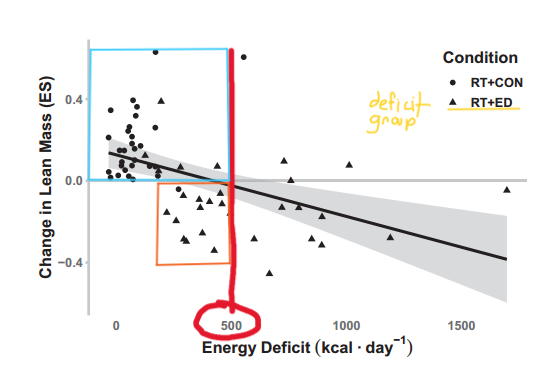
In the chart above, it can be observed that as individuals approached a 500 caloric deficit, they began to experience a negative impact in lean mass. The key spot appears in the blue square in the 0-500 calorie range. It is important to note that this number will vary from person to person. Many individuals began to see negative changes in lean mass at the 250-500 calorie range which can be seen in the orange square. With this data in mind, a moderate calorie deficit of around 300 calories per day is recommended.
Sufficient Protein
Protein is essential for building and repairing muscle tissue. It is generally recommended to consume around 0.7 to 1 gram of protein per pound of body weight (1.5 g/kg to 2.2 g/kg body weight). This will help to preserve muscle mass while in a calorie deficit. In a study on high protein diets combined with resistance training, they found consuming a higher amount of protein led to greater changes in body fat. The table below illustrates their findings.
| Protein Group | Daily Protein Consumption | Body Fat % Change |
| Normal | 0.54 g/lb (1.2 g/kg) | 2.2% decrease |
| High | 1.36 g/lb (3.0 g/kg) | 6.4% decrease |
Adequate Sleep
Sleep plays a crucial role in muscle development. When you’re asleep, your body enters an anabolic state, which means it focuses on building up rather than breaking down. Lack of sleep can lead to muscle loss and hinder fat loss.
In a study found here, they found that after 1 week of sleep restriction to 5 hours per night, daytime testosterone levels in a group of young healthy men decreased by 10% to 15%. Testosterone is the hormone that stimulates protein synthesis and inhibits protein degradation.
That is why it is recommended to get at least 7-8 hours of sleep every night.
Exercise Essentials
Resistance Training
Resistance training is effective because it helps to build and maintain lean muscle mass while also promoting fat loss. The results of this study suggest that resistance training is the most effective means for increasing lean mass (fat free mass).
It’s important to focus on compound exercises that work multiple muscle groups at once, such as squats, deadlifts, and bench press. Aim for at least 2-3 resistance training sessions per week (45 minutes to an hour), with a focus on progressive overload (gradually increasing the weight or resistance over time).
Cardiovascular Exercise
Cardiovascular exercise, also known as cardio or aerobic exercise, is another important component. It involves activities that get your heart rate up and increase your breathing rate, such as running, cycling, or swimming.
While resistance training is more effective for building and maintaining muscle mass, aerobic exercise was effective for reducing body fat (study). That is why it is important to combine cardiovascular exercise with resistance training
Conclusion
Body recomposition, requires a delicate balance of nutrition, exercise, and lifestyle habits. Success in body recomposition hinges on factors like body fat percentage and training experience. Individuals with higher body fat percentages will find it easier due to the body’s utilization of stored fat as an energy source during exercise. Experienced lifters will find body recomposition more difficult as the body responds less to exercise. By maintaining a moderate calorie deficit, prioritizing protein intake, engaging in resistance training, and incorporating cardiovascular exercise, a successful body recomposition is possible, albeit difficult to achieve.
Remember, body recomposition isn’t for everyone. Thank you for reading and feel free to comment below!
about this self proclaimed best midtown trainer
I am a certified personal trainer based in the heart of Midtown Atlanta. Keeping it simple, I like to get people in shape. It makes me happy and allows me to pay my bills. I am the least serious person you know and I promise I am easy to talk to. Oh yeah I also like anime and video games. If you want to get in to fitness, I’m probably your guy. Just send an email my way and I’ll get back to you.